

Struggling economy. Corrupt political class. Static interest rates. Yet Mexico’s house prices rose by 9.19% during the year to Q2 2019, according to the SociedadHipotecaria Federal (SHF). Adjusted for inflation, house prices increased 4.78% y-o-y in Q2 2019.
On a quarterly basis, house prices rose by 2.44% (2.31% inflation-adjusted) during the latest quarter.
What´s even stranger is that this sudden take-off of the housing market comes after Mexico’s housing market has suffered prosaic growth for a decade, in real (inflation-adjusted) terms, despite strong nominal growth:
| MEXICO HOUSE PRICE INDEX, ANNUAL CHANGE (%) | |||
| Year | Nominal | Inflation-adjusted | |
| 2009 | 4.75 | 0.75 | |
| 2010 | 3.70 | -0.53 | |
| 2011 | 5.90 | 2.32 | |
| 2012 | 2.90 | -1.17 | |
| 2013 | 4.07 | 0.40 | |
| 2014 | 5.12 | 0.90 | |
| 2015 | 6.71 | 4.34 | |
| 2016 | 5.82 | 2.49 | |
| 2017 | 8.56 | 1.85 | |
| 2018 | 9.35 | 4.32 | |
| Sources: SociedadHipotecaria Federal (SHF), Global Property Guide |
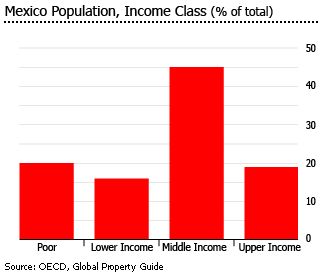
The secret is Mexico´s enormously strong domestic market, particularly the rising middle class. In 2018, the country’s middle class was estimated to account for almost half of the total households, at about 16 million. They are expected to continue growing, with about 3.8 million more households projected to move into the middle class by 2030. Moreover, most Mexicans who move generally prefer to buy rather than to rent. Around 82% of Mexicans want to buy a property, as opposed to 18% that prefer to rent, according to Lamudi’s recent Real Estate Market Report 2018.
Foreign demand is also rising again. American and Canadian buyers are returning to Mexico, after a several-year slump, thanks to low oil prices and the strong US dollar, pushing home values up.
The Mexican housing market is not driven by speculators. There are many developers, and it is highly competitive. Interest rates are (relatively) low in the social sectors, due to subsidies. Housing demand in Mexico is “real”, says Citibanamex’s Executive Director of Mortgage and Automotive Credit Ricardo García Conde, meaning that the house price movements in Mexico are mostly due to supply and demand with a minimum percentage of speculative purchases.
While the general outlook for Mexico’s housing market remains robust, the country’s ailing economy, coupled with the uncertainties surrounding the ratification of NAFTA (now rebranded as USMCA) and the ongoing US-China trade dispute, might adversely impact the market in the coming months.
Strong demand from foreign buyers
In recent years, American and Canadian buyers have been returning to Mexico, after a several-year slump, thanks to low oil prices and the strong US dollar, pushing home values up.
Mexico ranks first among 30 favourite US and Canadian destinations for second home searches in 2018, up by three notches from 2015, according to Point2 Homes.
American buyers are very important as owners of beachfront properties. Some of the most sought after Mexican destinations on Google last year include Puerto Vallarta, Cancun, Playa del Carmen, Cabo San Lucas, and San Miguel de Allende.
In Mexico City, foreign buyers (mostly from Brazil, Spain, and US) tend to invest in new construction or commercial properties, and are in the city for work.
The rising middle class
In 2018, the country’s middle class was estimated to account for almost half of the total households.
The middle class is expected to continue growing, for several key reasons:
First, inflation has halved: it was close to 10% in 2000, but between 2005 and 2018 the rate has hovered around 4%. The autonomy of the Bank of Mexico has played a key role. However, the massive gas price hikes drove Mexico’s inflation rate to a 16-year high at 6% in 2017. This pressured the central bank to bring inflation back to its +/-3% target.
Second, there is now trade openness. As a percentage of the economy, foreign trade (exports plus imports) account for nearly 60% of GDP, making Mexico one of the most open economies in the world. By way of comparison, the figure is 27% in Brazil, 48% in China and 30% in the United States. This fosters competition and puts an upper limit on the price of goods in the local market.
Third, there is the prudent management of public finances. Between 2000 and 2012, the fiscal deficit was below 1% of GDP. The Mexican government targets a fiscal surplus of 0.7% of GDP this year. Total public debt, domestic and foreign, remains below 50% of GDP in 2018.
Fourth, financial inclusion. The population using banking services rose from 33 million in 2006 to 51 million in 2012. Yet 66% of adults in Mexico do not own a bank account, so in 2016 the government launched the National Financial Inclusion Strategy (NFIS) to accelerate access to financial services for the population currently left out. Moreover the FinTech Law, passed in March 2018, which aims to develop Mexico’s own Open Banking Standard by 2020, is expected to help foster innovative solutions for people currently excluded from the financial system.